Skip to content

This is a case study about a media house located in Mumbai, India, with more than 500 employees. The company is an industry-leader in radio spot monitoring, providing tools for broadcasters, ad agencies, advertisers, and industry analysts.
The organization relies on a diverse workforce that works in multiple shifts round-the-clock to serve a global customer base and keep operations running smoothly at every hour of the day. This media house was using paper-based approach to manage multiple shifts and record employee work hours, which led to several challenges.
Industry
Media and Entertainment
Location
India
Employees
500+
Key Outcomes
- » Optimal utilization of workstations
- » Attendance data accuracy
- » Efficient shift management
- » Accurate calculation of overtime
- » Reduced manual effort
- » Improved discipline & productivity
- » Boosted business outcomes


“Empxtrack team understood our challenges and offered the best solution. Real-time attendance integration has helped us manage our staff efficiently and boost productivity. Thank you to the entire team for quick implementation and highly responsive support. We appreciate their excellent customer support that helped in smooth running of leave, attendance and payroll processes. I’m sure you are up to do wonders.”
Ajay Shukla | Manager Human Resources | Aircheck
CHALLENGE
The company had invested in office space at one of the city’s most high-class suburban real estate properties. Leadership expected high returns from this investment.
Unfortunately, the revenue growth did not meet expectations when the new workspace became operational. As a result, the company ended up losing profits due to under-utilization of work stations. Internal teams analysed the situation and found a few shortcomings:
- 1. Underutilized workstations: Over 20 percent of work stations were unoccupied or used insignificantly leaving gaps in optimal utilization of resources.
- 2. Inefficient Shift Management: It was difficult to manage shifts for employees. This led to a fewer number of employees at some times and a larger employee population at other times.
- 3. Lack of Workforce Visibility: Managers needed an automated tool to know the availability of employees in a specific shift and keep work stations optimally utilized.
- 4. Shared Workspace Constraints: Since same work stations were used by employees in different shifts, each shared work desk needed to be freed by a specific time. So that employees coming in the next shift could start using it the moment they were at work.
- 5. Limited Data for Short Hours: When employees needed to compensate for short working hours, managers didn’t have data to identify available work stations in the specific shift.
- 6. Leave Visibility Issues: It was not possible to identify employees on leave, such that their work station could be re-assigned to other employees.
- 7. No Short Hours Visibility: Employees had no way to check the number of short hours in a month, so that they could regularize them in a timely manner.
Particularly, these challenges were difficult to solve through a paper-based approach – as it was time consuming and had more chances of errors.
The client discussed these challenges with Empxtrack Team, with an aim to cover loss of infrastructure costs, increase accuracy in real-time attendance data, improve employee productivity and boost overall business outcomes.
SOLUTION
Empxtrack team provided solutions to overcome several complex issues, including shift management, capture of attendance data in real-time, accurate calculation of overtime for each employee, identification of late comers, and provided employees with the option to compensate for short hours with their manager’s approval.
With the automation of the process and implementation of Empxtrack, the team handled all complex issues.
1. Managers can check the total number of employees present in a specific shift. The company used Empxtrack attendance and shift management tool to record in-and-out time of each employee. Moreover, the system highlighted late comers, absentees, overtime, and short hours for individuals. It made it easy for managers to pull real-time attendance data of their team members in a single click.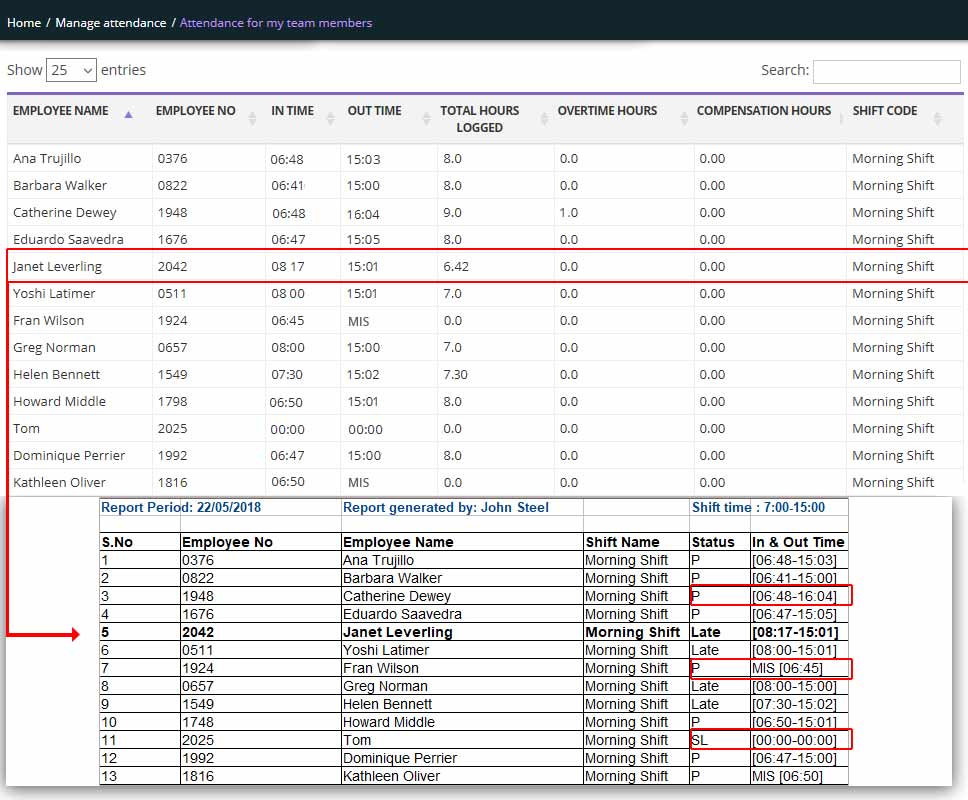
Image 1: Identify late comers and early goers, and record their short-working hours. Janet, Yoshi, Greg and Helen are the late comers. SL shows Sick Leave. There is only one absentee on 22ndMay 2018. MIS shows Mispunch for employees who haven’t marked their Out-Time on the online attendance portal. An employee, Catherine, has worked for 9 hours. Her overtime is 1 hour.
2. Managers get an easy way to manage overtime hours. They can use the system to approve overtime requests of their subordinates as per the workforce requirement in the shift.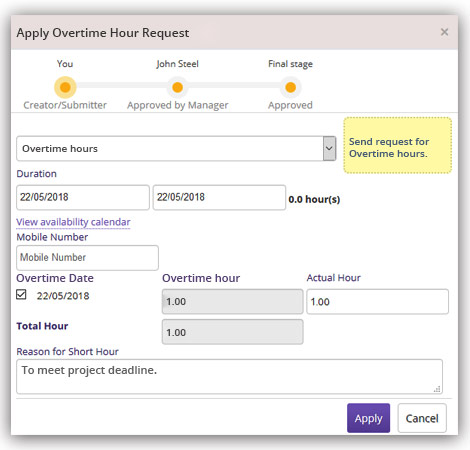
Image 2: Employees can send request for overtime. Catherine applied the request asking her manager to work for an extra hour on 22ndMay 2018 to meet project deadline. Manager can respond on Catherine’s request after checking the availability of work station on the specific date.
3. Employees get an option to request their manager to compensate for short hours.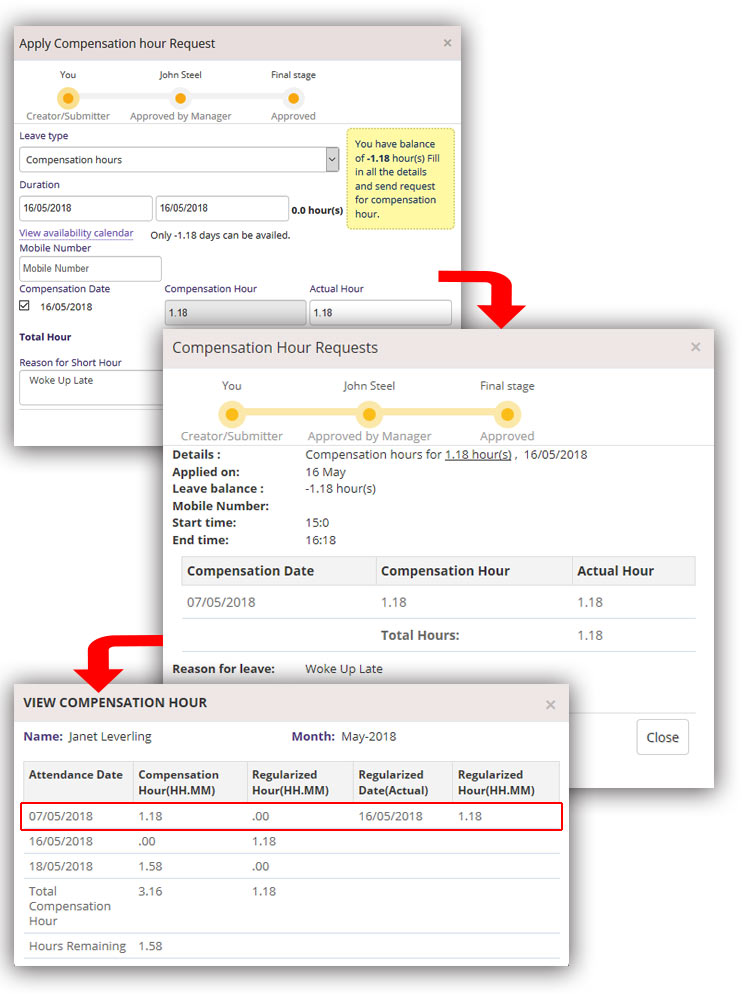
Image 3: An employee can send request to compensate short hours. The manager approves the request depending upon the shift requirements. Once the employee compensates the committed hours, it gets regularized in the database.
4. Managers can capture and analyze attendance data on their system with a click of a button. Earlier, managers used to compile time-consuming reports on their own to check the attendance records of their subordinates. The automation of the process made it easy for. Furthermore, the managers analysed data on time to take necessary disciplinary action for employees for frequent absences and short working hours.
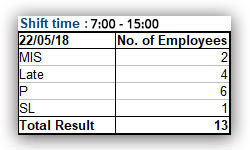
Image 4: Managers can get a consolidated report of absentees, late comers, and total number of employees present in a shift.
BENEFITS
Successful implementation and strategic use of the product has maximized business performance and minimized operational costs. Other remarkable benefits are:
▸ Optimum utilization of workspace by keeping all work-stations occupied for maximum time.
▸ Real-time attendance visibility for managers across their entire team in just one click.
▸ Clear visibility of employees’ availability, including present staff and late comers, along with their actual punch time.
▸ Identification of employees who have short working hours in a month and providing them with an option to compensate for their short hours before the next payroll cycle.
▸ Flexibility in work schedules by providing options to compensate for short hours.
▸ Better visibility and easy tracking of employee work hours.
▸ Efficient management of complex shifts for a large set of employees with a single click.
▸ Better discipline in the organization.
▸ Increased returns on infrastructure investment.
Disclaimer: Maintaining security of our client data is our prime responsibility. The images shown in this case study contain dummy data.